

by Dip Patel, CTO
For decades, we’ve built a cloud optimized for humans — not machines.
That cloud was about people: real-time transactions, video streaming, milliseconds of ping, and proximity.
This has driven a huge premium in “tier-1” cities for data center space, which in turn causes havoc to the local electrical grid, water table, and environment.
The AI cloud is different. It’s about power, scale, and physics.
It’s far easier to move information than it is to move power.
The first digital decoupling:
When COVID hit, the internet quietly rewired the physical world. Using the internet, we stopped moving people to offices, and the world was handled on Zoom.
Traffic disappeared. The skies cleared. Even whales returned to the coast.
The earth was healing.
That was the first great digital decoupling — the moment we learned that work, learning, and creativity didn’t have to orbit the city center.
The next decoupling will be data centers.
And, just like companies that ignored hybrid work, those that ignore this shift will go extinct.
Over the last six weeks, I’ve met the people trying to scale everything that fuels AI:
Power. People. Pipes.
I learned that a lot of them are still stuck in the real estate mindset that defined the last cloud.
They’re chasing Tier-1 metros, zoning maps, and carrier hotels (internet exchange buildings), because that’s where the internet used to live. That cloud was built for serving websites and YouTube.
But the AI cloud doesn’t need to live there.
It doesn’t chase clicks or milliseconds. It chases megawatts.
We’ve crossed into a new paradigm — one where companies built for location are now facing a world that needs power.
Companies that have built their entire DNA tending to horses (location) are now staring at a car (power).
In the traditional cloud, every millisecond of ping mattered. You wanted to be as close as possible to Internet exchange points (Ashburn, Dallas, Columbus).
In the AI cloud, proximity takes on a new meaning.
What matters now is how fast GPUs talk to each other inside the same building — not across the map. They communicate at 3,200 Gbps across GPU nodes and 1.8 Tbps within a single motherboard.
Outside of the building? Latency is a lot less sensitive.
Training workloads run for days or weeks. A few milliseconds (ms) make no difference.
Inference workloads are more mixed: only 10–20% demand sub-10 ms latency for real-time use cases such as robotics or autonomous systems.
The rest? They’re perfectly fine in the 10–100 ms range.
For every extra ms in latency, you can move a building 150 miles from a tier-1 city, where land, power, and permitting are easier.
Building new transmission is nearly impossible. Building new fiber is trivial.
| POWER (Transmission) | INFORMATION (Fiber) | |
| COST/km | $2–6M | $25–60K |
| TIMELINE | 5–10 years | <1 year |
| REGULATION | FERC + State + NEPA | DOT + County |
| RISK | Grid Instability | Minimal |
| FLEXIBILITY | Fixed | Infinite |
For decades, we brought power to the cities, but that was low-power compute.
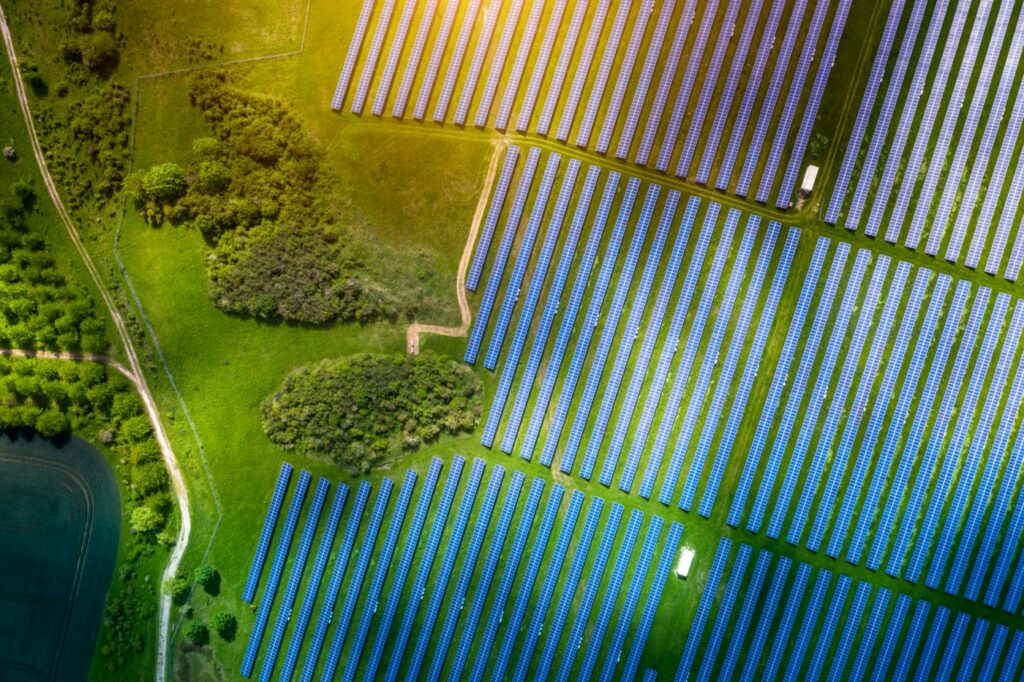
Now it’s time to bring cities of compute to the power.
This is the second decoupling, and the divide will define the next decade.
Companies still optimizing around Tier-1 real estate are building for the past.
The future doesn’t belong to whoever’s closest to an exchange point. It belongs to whoever’s closest to a substation.
Because in the AI era, it’s easier to move bits than electrons.
Learn more about Soluna visit → https://www.solunacomputing.com/