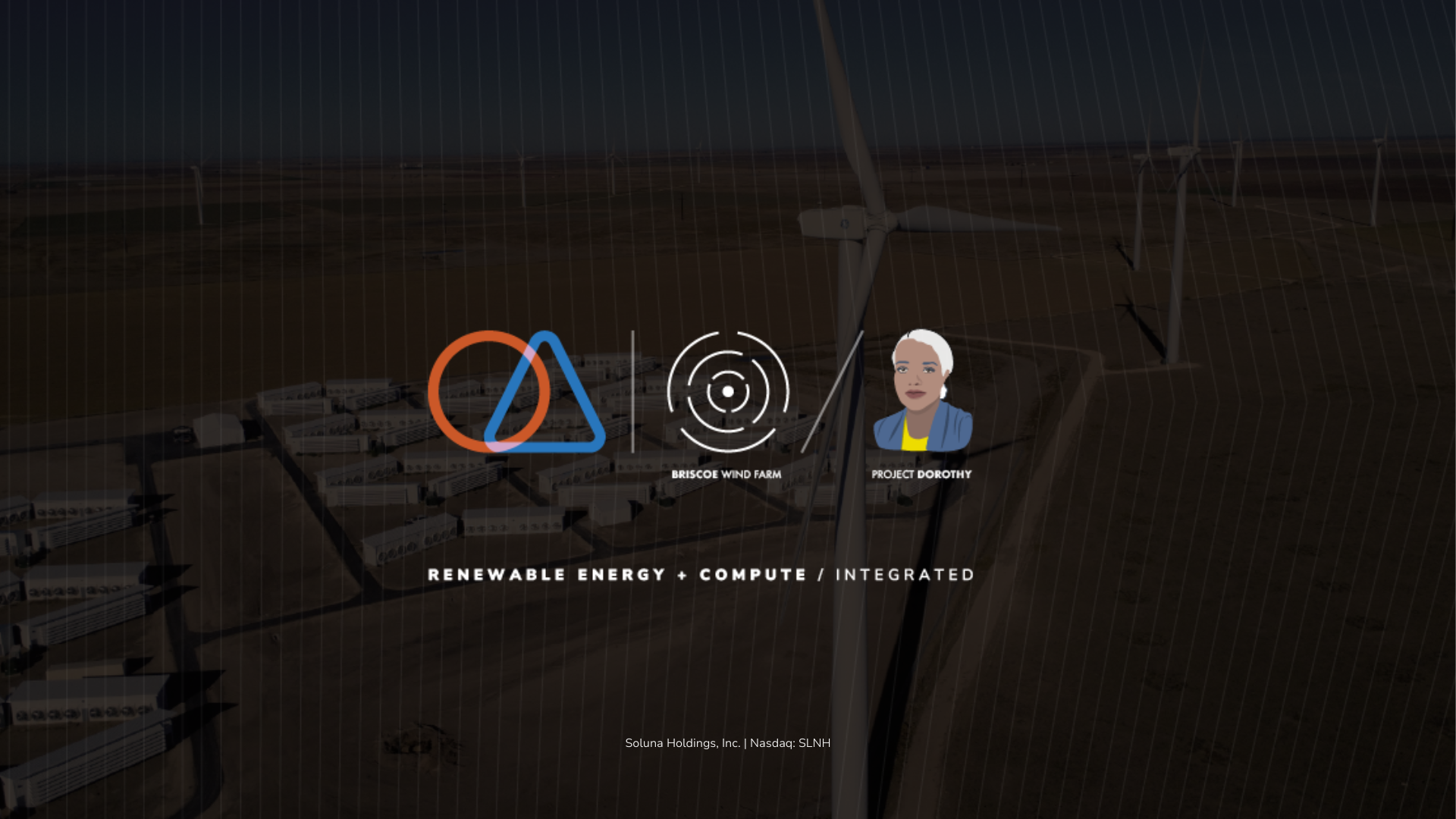


Soluna’s acquisition of the Briscoe Wind Farm marks a structural milestone in Soluna’s evolution from co-location to full vertical integration of renewable energy and compute infrastructure at Project Dorothy. Below, we answer the questions regarding the announcement.
Corporate & Strategic
Why did Soluna acquire the wind farm instead of continuing under a long-term PPA?
Owning the generation asset strengthens energy certainty and reduces reliance on third-party power contracts. For energy-intensive computing infrastructure, controlling power supply improves cost visibility, reduces counterparty risk, and accelerates speed to power for future expansion.
This is particularly important as Soluna advances plans for Dorothy 3, where securing power is critical to supporting future AI workloads. Vertical integration provides the energy foundation needed to scale the campus and reduces dependence on external power negotiations, thereby reducing development delays.
In addition, ownership allows Soluna to optimize between on-site compute demand and ERCOT market sales over the long term.
Is this a one-off transaction or part of a broader strategy to own generation assets?
This acquisition reflects Soluna’s strategy to support the growing demands of AI and high-performance computing, where energy availability and speed to power are critical constraints.
While co-location remains foundational to our business, vertical integration at Project Dorothy demonstrates how owning generation can strengthen energy certainty and accelerate development timelines for AI infrastructure. As Soluna advances plans for Dorothy 3, this approach provides a clear example of how integrated energy and compute can support next-generation workloads.
Soluna will continue evaluating opportunities to integrate generation where it strategically enables AI infrastructure development.
Does this acquisition change Soluna’s core identity? Are we now an energy company?
No. Soluna remains a developer and operator of digital infrastructure for energy-intensive computing.
However, we view vertical integration as an important strategic driver of the business. Owning generation strengthens the energy foundation that powers our data centers, improving speed to power, cost visibility, and long-term scalability—particularly as we expand into AI infrastructure.
You may see more of this approach over time, especially where it supports the development of AI campuses. Energy ownership enhances the platform; it does not change our core focus.
How does this transaction strengthen Soluna’s Renewable Computing strategy?
Renewable Computing™ is based on aligning flexible compute with renewable generation. Project Dorothy demonstrated that model through Bitcoin hosting. By owning the wind asset that powers the site, Soluna institutionalizes that model, aligning generation and compute infrastructure on a single platform.
This increases energy certainty, improves operational coordination, and strengthens long-term infrastructure durability. It also repositions Soluna in the AI infrastructure market, where access to power is the primary constraint. By owning generation, Soluna can accelerate speed to power and more quickly serve growing demand for AI and high-performance computing.
How does this acquisition bridge Bitcoin hosting and AI infrastructure?
Bitcoin hosting validated Soluna’s Renewable Computing model by demonstrating how flexible compute can align with renewable energy. AI workloads require similar energy-intensive infrastructure but on a larger scale. By securing generation ownership and expanding the Dorothy campus, Soluna is extending a proven infrastructure model to support the next generation of high-performance workloads, including AI.
Why was now the right time to complete this transaction?
Demand for AI and high-performance computing infrastructure is accelerating, and energy availability is increasingly the primary constraint to scaling new capacity. Acquiring the wind farm strengthens energy certainty at Project Dorothy and positions the site for future expansion, including the directional development of Dorothy 3.
Financial & Capital Structure
What was the purchase price?
The purchase price is $53 million.
How was the acquisition funded (cash, debt, equity, structured financing)?
The purchase price and closing adjustment for working capital are funded by balance sheet cash and $12.5m of funding from our Generate credit facility.
Does this affect liquidity or near-term capital needs?
Yes, the acquisition will be financed with a combination of cash and debt.
Is the transaction immediately accretive to EBITDA or cash flow?
Yes, the acquisition is expected to be immediately accretive. Projected annualized, Adjusted EBITDA is estimated to be between $6 million and $11 million, and projected annualized revenue between $20 million and $24.4 million.
How does ownership change the long-term power cost structure at Project Dorothy?
Behind-the-meter integration improves operating cost predictability while preserving flexibility to sell excess power into the ERCOT market when generation exceeds on-site demand.
Does this introduce new financial risks?
Owning a generation asset introduces operational and financial considerations that differ from our historical asset-light model, including maintenance obligations and exposure to equipment and site-level performance risks, among others. We believe these risks are manageable and consistent with our strategic objective of aligning generation and compute. Additional detail regarding the transaction, including its financial terms, is available in our Current Report on Form 8-K filed with the SEC on Thursday, April 2, 2026.
Operational
Is the wind farm 100% dedicated to Project Dorothy?
Dorothy will benefit from its existing behind-the-meter contract with Briscoe, which is expected to be upsized to accommodate Project Dorothy 3’s expected needs. Briscoe (and Soluna) will nevertheless preserve the flexibility to sell excess power when generation exceeds on-site demand.
Does Soluna now operate the wind asset directly, or does it have an operating partner?
Soluna is now the owner and will oversee management of the asset, supported by a best-in-class existing asset manager, Consolidated Asset Management Services (CAMS), and O&M provider (GE for wind turbines, and for the balance of plant, CAMS).
Does this change the operating strategy at Project Dorothy?
In the near term, no; the operating strategy does not change and the acquisition provides the site with longer-term security regarding control over the power purchase agreement. In the future, as our plans for Dorothy 3 progress, we may make changes to the operating plans for Dorothy 1 and 2.
Does this impact uptime, reliability, or performance metrics?
No, as the asset is operationally separate from the existing bitcoin mining and AI data center developments. In fact, reliability could improve from direct oversight of the preventative maintenance protocols implemented at the wind farm and substation.
Are there any remaining regulatory approvals or conditions?
No, the transaction has been effected as a simultaneous signing and closing, free of any conditions precedent. All regulatory communications and notices have been completed.
Does this change expansion timelines at Project Dorothy?
No, Dorothy 1 and 2 are both up and running.
Bitcoin Hosting
Does this acquisition change current hosting agreements or pricing?
No. Existing hosting agreements, pricing, and capacity at Dorothy 1 and 2 are unaffected by this transaction. Dorothy 3 is being developed on new land adjacent to the existing campus specifically to support AI and HPC expansion. Any future workload evolution would be communicated well in advance with structured timelines.
Does Dorothy 3 AI signal a shift away from Bitcoin hosting?
No. Bitcoin hosting remains a core part of Soluna’s platform. Dorothy 3 represents an expansion of the campus and the Renewable Computing model. As we have always said, Bitcoin validated the model. AI expands it.
Does this improve long-term stability of the campus?
Yes. Prior to this acquisition, Project Dorothy sourced power through a third-party PPA agreement. Owning the Briscoe Wind Farm outright eliminates that counterparty dependency, improves long-term cost visibility, and secures the power supply behind the campus on a durable basis. For hosting customers, that translates to greater operational certainty over the long term.
AI / HPC
Does ownership of generation improve contract stability?
Yes. Owning the generation asset that powers Project Dorothy strengthens both energy certainty and speed to power for infrastructure deployments. By controlling the power source behind the AI data center campus, Soluna reduces reliance on third-party power agreements, lowers counterparty risk, and aligns energy production directly with compute demand. This creates a more stable and predictable foundation for long-term infrastructure contracts.
How does this reduce exposure to energy price volatility?
For now, the current structure of the PPA for Dorothy 1 and Dorothy 2 remains the same, so it will continue to draw power from the grid at wholesale rates.
Does this support future expansion into AI?
Yes. Energy availability is the primary constraint for scaling AI and high-performance computing infrastructure. By securing generation behind the Dorothy campus, Soluna strengthens its ability to deliver energy certainty and accelerate speed to power for future AI deployments.
Is Project Dorothy being positioned for AI workloads?
Project Dorothy 1 and 2 validated the Renewable Computing model through Bitcoin hosting. With the acquisition of the wind asset and the planned expansion of the campus with Dorothy 3, the site is now expected to be positioned to support additional high-performance workloads, including AI, as demand evolves.
Energy Market
Will Soluna pursue additional generation acquisitions?
Soluna will continue to evaluate opportunities to vertically integrate generation where it strategically strengthens infrastructure development. We are not an energy company, but we recognize that owning power generation can be a meaningful lever for the right campus. While co-location remains foundational across our portfolio, vertical integration enhances energy certainty, improves speed to power, and supports long-term expansion — particularly as we advance AI infrastructure. You may see more of this going forward.
Is this model replicable across other campuses?
Yes. The Renewable Computing model was designed to be scalable across multiple locations. Co-location with renewable generation remains the core approach, and in certain cases, vertical integration can further strengthen the platform by improving energy certainty and enabling faster expansion for compute workloads such as AI.
Market Perception & Risk
Is this a defensive move due to Bitcoin margin compression?
No. The strategic rationale for owning generation at Project Dorothy is unrelated to the current Bitcoin hashprice environment. Vertical integration has always been the logical next step in the Renewable Computing model — co-location proved the thesis, ownership institutionalizes it. It’s about leveraging the power of convergence.
We expect this acquisition to improve the platform’s long-term economics, regardless of which workload is running. Behind-the-meter ownership reduces operating cost exposure, eliminates third-party power agreement risk, and accelerates speed to power amid the growing demand for AI infrastructure. The timing reflects the asset’s availability, not a reaction to margin dynamics in any single workload.
Are you taking on energy market risk you did not previously have?
Previously, Project Dorothy was exposed to third-party power agreement risk — renegotiation cycles, counterparty dependency, and external pricing decisions. Ownership replaces those risks with a different profile: direct exposure to wind generation variability and asset-level operating costs.
The Briscoe Wind Farm has an established operational track record, which was a material factor in the acquisition decision. Additionally, when wind generation exceeds on-site compute demand, surplus power can be sold directly into the ERCOT market, preserving revenue optionality and partially offsetting generation variability. On balance, we believe the ownership risk profile is more durable and controllable than continued reliance on third-party power structures at this location, particularly as we scale AI infrastructure at the site.
Why concentrate more capital in a single campus?
Project Dorothy is Soluna’s most operationally proven asset — years of behind-the-meter operations, demonstrated energy alignment, and a hosting track record that validated the Renewable Computing model at scale. Deepening investment continues to prove that.
It also reflects where Dorothy sits within the broader platform. Soluna’s development pipeline extends across multiple sites — Dorothy, Kati, Grace, and additional projects in development. Vertical integration at Dorothy strengthens the infrastructure model that every other site in that pipeline is built on. What we prove here, we may replicate elsewhere.
Generate Capital has visibility into the deal and continues its support of Soluna in this transaction. We view support from this market leader as a positive validation of our strategy.
Long-Term Strategy
Does this become the blueprint for future Soluna campuses?
Every major step in Soluna’s development has informed the next one. Dorothy 1 proved the Renewable Computing model. Dorothy 2 proved it was repeatable. We expect the Briscoe acquisition and the vertical integration it brings to strengthen it further. How that learning applies to future sites will depend on site-specific conditions.
How does this acquisition impact the broader development pipeline?
Soluna’s development pipeline exceeds 1 gigawatt of potential computing capacity, backed by a long-term power pipeline of over 4.3 gigawatts. The Briscoe acquisition does not change that pipeline.
Community & Regional
Does this change local employment or operations?
Expanding our business portfolio only creates more opportunities for roles at Soluna. We have already hired a new local asset manager to support this business. The asset is operationally separate from the existing bitcoin mining and AI DC developments, so it will not impact our current teams. The asset continues to require the same maintenance it always has, so the relationships in place and the teams the wind farm employs to support its operations remain intact.
Project Dorothy 3
What is the plan and timeline for Project Dorothy 3 AI campus?
It is our planned next AI campus at Project Dorothy. The Briscoe acquisition sets the energy foundation. More details will follow as we advance the project this year.
How big will it be?
Up to 300 MW.
What will happen to project Grace?
Project Grace is continuing. It remains an important part of our AI infrastructure technology development, and we will share updates as the project progresses.
How will you finance this build-out?
We expect to use a combination of project-level and parent-level debt and equity financing. We will provide more information as the project develops.
What is the development plan for Dorothy 3?
We will provide more information as the project develops.
Safe Harbor Statement
This announcement contains forward-looking statements. These statements are made under the “safe harbor” provisions of the U.S. Private Securities Litigation Reform Act of 1995. These forward-looking statements include all statements, other than statements of historical fact, regarding our current views and assumptions with respect to future events regarding our business and our expectations with respect to the development of Project Dorothy 3, the expected financial contribution of the Briscoe Wind Farm acquisition, including projected Adjusted EBITDA and annualized revenue, our other sites and development pipeline, our approach and strategy relating to vertical integration, the financial and other impacts of the acquisition on our business, and other statements that are predictive in nature. These forward-looking statements can be identified by terminology such as “will,” “expects,” “anticipates,” “future,” “intends,” “plans,” “believes,” “estimates,” “confident,” and similar statements. Readers are cautioned that any forward-looking information provided by us or on our behalf is not a guarantee of future performance. Actual results may differ materially from those contained in these forward-looking statements as a result of various factors disclosed in our filings with the Securities and Exchange Commission (“SEC”), including the “Risk Factors” section of our Annual Report on Form 10-K filed with the SEC on March 27, 2026. All forward-looking statements speak only as of the date on which they are made, and we undertake no duty to update or revise any forward-looking statements, whether as a result of new information, future events, or otherwise, except to the extent required by law.
Non-GAAP Measures
In addition to figures prepared in accordance with generally accepted accounting principles (“GAAP”), Soluna from time to time may present alternative non-GAAP performance measures, e.g., EBITDA, adjusted EBITDA, adjusted net profit/loss, adjusted earnings per share, free cash flow, both on a company basis and on a project-level basis, among others. EBITDA is defined as earnings before interest, taxes, and depreciation and amortization. Adjusted EBITDA is defined as EBITDA adjusted for stock-based compensation costs, provision for credit losses, loss on sale of fixed assets and credit on equipment deposit, provision for credit losses, impairment on fixed assets, fair value adjustment loss (gain), fair value on placement agent warrants financing fee, and loss (gain) on debt extinguishment and revaluation, net. Projected Year-One Adjusted EBITDA is a non-GAAP financial measure; however, Soluna cannot predict with certainty the magnitude or scope of certain items that would be included in the most directly comparable GAAP measure for the relevant future periods, and such items may be significant. Due to these uncertainties, Soluna cannot provide a quantitative reconciliation of projected Year-One Adjusted EBITDA to the most directly comparable GAAP financial measure without unreasonable effort. The impact of differences in projected Year-One Adjusted EBITDA and annualized revenue contributions from those estimates provided in this press release could have a material impact on the business’s overall operating results. Project-level measures may not take into account a full allocation of corporate expenses. These measures should be considered in addition to, but not as a substitute for, the information prepared in accordance with GAAP. Alternative performance measures are not subject to GAAP or any other generally accepted accounting principles. Other companies may define these terms differently. See our annual report on Form 10-K for the year ended December 31, 2024, for an explanation of how management uses these measures in evaluating its operations. Investors should review the non-GAAP reconciliation included in the Company’s periodic filings with the SEC and should not rely on any single financial measure to evaluate the Company’s business.